
Some may think that gender inequality is a thing of the past. However, contemporary authors like to remind us this is not the case. Using an interesting premise, author Camen Maria Machado calls attention to the issue of gender inequality while providing an engaging tale of an unnamed woman as she falls in love and becomes a loving wife and a mother. “The Husband Stitch,” a short story published in her first book, “Her Body and Other Parties,” explores the intersection of myth and reality, gender roles, and highlights vulnerabilities women must protect in a male-dominated world that seeks to control and define them. The unique element in the story is the presence of a green ribbon tied around the protagonist’s neck. Her husband insists on removing it and finally does, with horrific consequences. It is a multilayered piece of literature encapsulated in a dozen pages. The story touched upon many different themes, including myths and personal truths through storytelling, the power of narrative shaping gender roles, the critique of the objectification of women’s bodies, and the difficulty of women maintaining their personal identities in a marriage.
Machado is a passionate storyteller who believes in the power of narrative to shape personal truths. There is an old, scary tale for children called The Green Ribbon. It is about a girl who wears a green scarf around her neck and never takes it off. A boy who became her boyfriend and husband keeps asking her to take it off throughout the story, and in the end, she finally does, and her head falls off. Machado took this old children’s folktale and transformed it into contemporary literature. It is such a fantastic reimagining of a simple yet effective story, utilized to touch on deeper truths and call attention to a social injustice that still exists today.
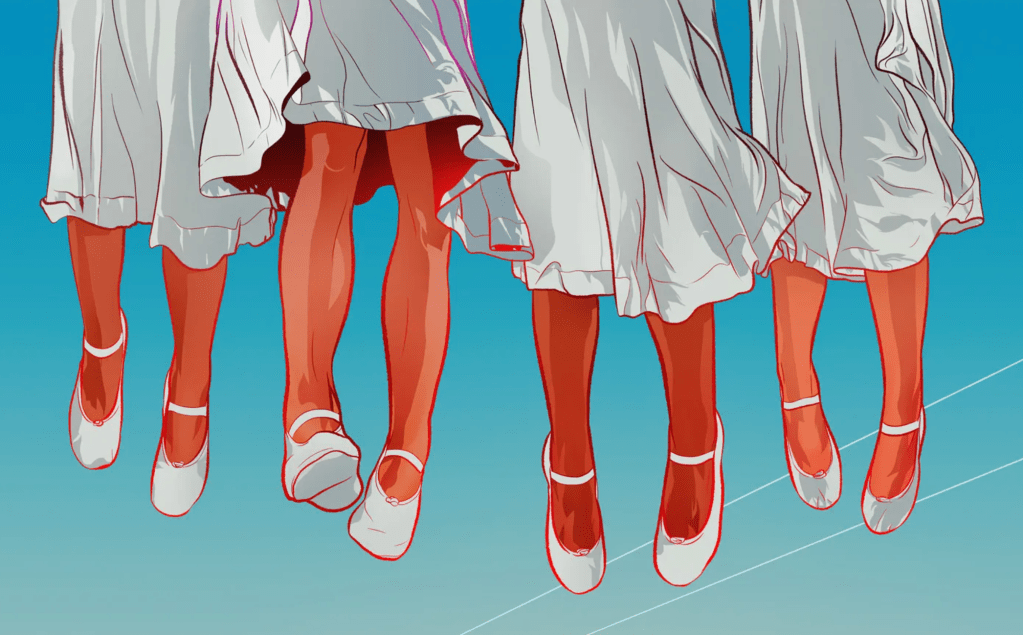
[Image credit, screen shot of the video from “The Green Ribbon” (from In a Dark, Dark Room and Other Scary Stories, by Alvin Schwartz)
https://www.youtube.com/watch?v=VH_qxW7wQFU
In an interview at the Miami Book Fair in 2017, Machado explained the inspiration for rewriting this children’s tale:
It had the story of the green ribbon in it, and I remember reading it and being just really yeah! It was just seared into my consciousness in this really intense way and years later I found myself thinking about it again and realizing that I had this sense of the stories in the story. Like I had this idea of thinking about what I would call good man entitlement. Like entitlement that men have that isn’t as obvious, sort of more boorish kinds of sexism. (PBS Books)
Even at a young age, these stories have already indirectly introduced the imbalance of gender inequality to the author’s mind. Years later, an impressionable children’s tale became the basis for critiquing sexism. It is fascinating to observe the roots and inspirations of ideas hidden between the lines of the stories we tell. Machado described her childhood in an article for the Paris Review: My family read to me a lot, and my grandfather’s Cuban, so there was a lot of storytelling in our household. I learned about stories through that oral tradition and through reading, and as soon as I was able to pick up a pen I was writing “books” and “stories” and sending them to publishers. (Kane). We can see the effects and inspirations of storytelling dripping from the pages of her work.
Beyond being a well-crafted retelling of a children’s tale, The Husband Stitch has so many layers that the reader might be awestruck by its complexities. The narrator tells many stories she remembers being told to her, which always involve something bad happening to a girl or a woman. This meta layering of substories within the main story while giving instructions on reading the story aloud is like a snake eating its own tail. A meta tesseract, if you will. Machado provides instructions throughout the story, which hints that this tale was made to be read out loud. But the absurdities of her instructions make it clear that it wasn’t. If you are reading this story out loud, give a paring knife to the listener and ask them to cut the tender flap of skin between your index finger and thumb. Afterwards, thank them (Machado). Furthermore, there is a particular “sub” tale within the tale that perfectly encapsulates this story’s main theme. It is an urban legend about a wife who is so afraid of her husband that she carved out her own liver to cook for him. In the story’s original ending, the wife did not cut out her own liver. She stole it from a corpse in the church next door. However, the protagonist modified it to reflect the harsh reality of the female experience. She changed the ending to show the lengths a wife may go through to satisfy her husband. That may not be the version of the story you’re familiar with. But I assure you, it’s the one you need to know. (Machado) In the main story, Machado does the same thing. She modified the narrator’s tale from the Green Ribbon to create the same effect. It is storytelling inception.
Besides the masterful craftsmanship of the narration, the protagonist’s voice is effectively depicted, drawing the reader into the complex and intimate landscape of the female experience. The protagonist is funny, strong-willed, and knows what she wants, at least at the beginning of the story. Her sexual experiences were intimately written and laid out plainly and casually, a refreshing and well-received style that is lacking in many other authors’ works. Machado stated in an interview that sometimes people describe “The Husband Stitch” as erotica, and I like erotica, but that’s not erotica. The story is not serving the sex, the sex is serving the story. (Kane). The reader will certainly understand what she meant after reading her work. The thoughts and experiences of the protagonist are very much a part of her identity and well-being. Without it, the story would be missing a key piece of its foundation.
As for the plot, on the surface, the protagonist is seemingly living her best life, while underneath belies turmoil and suffering. She has a good husband, a wonderful son, and a relatively strife-free existence. But she struggles with purpose, with her role as a mother and a wife, and the violation of boundaries her husband imposes on her. Such is the reflection of the real world, where some may assume this is a good life (and role) for the woman in our society. This story tells us otherwise. At one point, when the wife is pregnant, the husband asks, Will the child have a ribbon? The narrator writes, “I feel my jaw tighten. My mind skips between many answers, and I settle on the one that brings me the least anger. There is no saying now.” (Machado). Why is she angry at such a question? Because her husband is oblivious. She doesn’t know because they don’t know if the baby will be a boy or a girl yet. She will know only after the baby is born and the sex of the child is revealed. No ribbon. A boy. I begin to weep and curl the unmarked baby into my chest (Machado). She is grateful that her child doesn’t have the burden she and countless other women have to bear. In her world, or maybe metaphorically in ours, we can assume that only girls are born with ribbons tied around their necks or other body parts. Indeed, in the story, she met other women with ribbons. These ribbons are the woman’s most intimate parts that can’t be shared with anyone. They symbolize personal boundaries and marks of identity. They also serve as bonds between women, a shared suffering. And lastly, they represent the objectification of women, gift-wrapped as presents to the men in their lives.
Machado’s depiction of the “boorish kind of sexism” is further hinted at with the practice of “the husband stitch”. It is an extra stitch doctors add during surgical repairs to a woman’s body after childbirth. Vaginal cuts were common in the past decades, and stiches were needed to repair them afterwards. To quote from a health.com article, episiotomies started to become commonplace during the 1920s. Healthcare providers advocated that episiotomies helped prevent natural tears and reduced infant and maternal death during childbirth. Some claimed that an episiotomy would prevent urinary incontinence and prolapse. By the 1950s, healthcare providers performed episiotomies in about 84% of vaginal deliveries. (Brennan).
In 2006, the American College of Obstetricians (ACOG) advised against episiotomy unless medically necessary. By 2011, the episiotomy rate was only 9.4% in the United States. Episiotomy is prevalent in many low-and-middle countries, where its use became popular during the 1990s. (Brennan). Through anecdotes and experiences from women after giving birth, some are still receiving the extra stitch without their knowledge. Machado draws upon this horrendous procedure to represent the abuse of the female body without their consent. In the story, the protagonist is given the stitch after childbirth. She tried to protest but was too weak to do so. However, a lack of protest does not necessitate consent. She should have been asked directly. As in most real-life cases, neither the husband nor the doctor did so, as shown in the following excerpt.
My husband jokes around with the doctor as he holds my hand.
– How much to get that extra stitch? he asks. You offer that, right?
– Please, I say to him. But it comes out slurred and twisted and possibly no more than a small moan. Neither man turns his head toward me.
The doctor chuckles. You aren’t the first –
I slide down a long tunnel, and then surface again, but covered in something heavy and dark, like oil. I feel like I am going to vomit.
– the rumor is something like –
– like a vir– (Machado)
But starting in the 1980s, high-quality research on episiotomies was released, demonstrating that routine episiotomies cause the very issues they were thought to prevent, leaving many women with more severe tissue trauma and other negative long-term outcomes, including painful intercourse (Ruben). Thankfully, the opinion and practice of episiotomies, and subsequently, the husband stitch, have declined over the decades. As an example, the opinion of one real-life health practitioner stated: “The fact that there is even a practice called the husband stitch is a perfect example of the intersection of the objectification of women’s bodies and healthcare. As much as we try to remove the sexualization of women from appropriate obstetric care, of course, the patriarchy is going to find its way in there,” Tillman told Healthline. (Ruben)
There is a subtle assumption that when a woman marries a man, she becomes his property. The man takes ownership of the woman. This relic way of thinking still lingers in many cultures around the world. Throughout the story, the husband tries repeatedly, eventually harshly and forcefully, to remove the green ribbon.
– A wife, he says, should have no secrets from her husband.
– I don’t have any secrets, I tell him.
– The ribbon.
– The ribbon is not a secret, it’s just mine.
– Were you born with it? Why your throat? Why is it green?
I do not answer.
He is silent for a long minute. Then,
– A wife should have no secrets. (Machado).
The result of this way of thinking, as we saw, is the horrific end of the woman. This story reminds us that we all have boundaries that must be respected. Crossing them may yield unintended consequences.
Even today, women are still paid less, are less likely to be promoted to top positions, and still face a great deal of pressure to focus on responsibilities at home. In 2022, in the U.S., women earned 82% of what men earned. These results are similar to the pay gap in 2002, twenty years prior, when women only earned 80% as much as men (Pew Research Center). Whether or not the husband stitch is still given today is not as relevant as the mere existence of such a practice. Carmen Machado has taken this symbol of female violation to heart and served it up as cooked liver. She reminds us that although we have taken steps toward eliminating gender inequality, the Husband Stitch tells us we still have a ways to go.
References:
“Gender Pay Gap Facts.” Pew Research Center, 1 Mar. 2023, http://www.pewresearch.org/short-reads/2023/03/01/gender-pay-gap-facts/.
Brennan, Shannon. “What Is a Husband Stitch?” Health, 7 Oct. 2022, www.health.com/condition/pregnancy/what-is-a-husband-stitch.
Kane, Lauren. “Pleasure Principles: An Interview with Carmen Maria Machado.” The Paris Review, 3 Oct. 2017, www.theparisreview.org/blog/2017/10/03/pleasure-principles-interview-carmen-maria-machado/.
Machado, Carmen. Her body and other parties: stories. The Husband Stich. Graywolf Press, 2017.
PBS Books. “Carmen Maria Machado on “Her Body and Other Parties” at the 2017 Miami Book Fair”. YouTube, 28 June 2023, http://www.youtube.com/watch?v=4kD1iVPiAQA.
Ruben, Mallory. “Husband Stitch Is Not Just a Myth.” Healthline, 15 July 2022, http://www.healthline.com/health-news/husband-stitch-is-not-just-myth#The-history-of-episiotomies,-from-popular-to-discouraged.
Schwartz, Alvin. “In a Dark, Dark Room and Other Scary Stories”. I Can Read. Harper Collins. March 1984.
Williams, Katlyn. “Interview with Carmen Maria Machado.” The Iowa Review, 15 Nov. 2017, https://iowareview.org/blog/interview-carmen-maria-machado.




 Huey Ly
Leave a comment